

Description
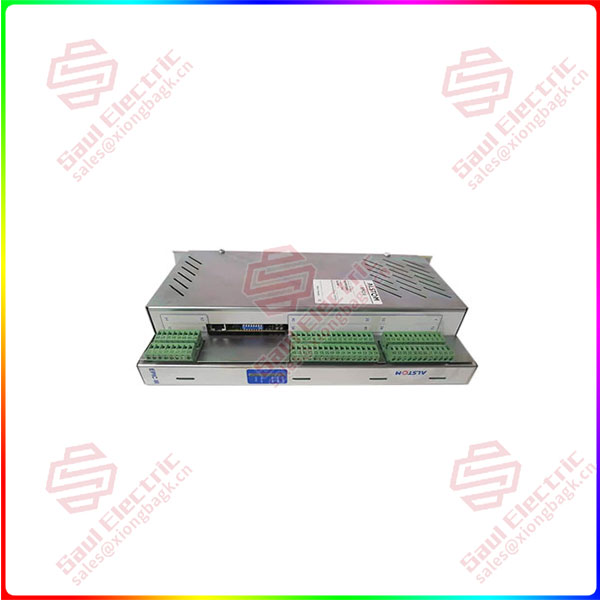
ALSTOM EP3-G-4-A-RU — Digital Feeder Protection Relay
Product: EP3-G-4-A-RU, Numerical Protection Relay
Manufacturer: Alstom Grid (now part of Hitachi Energy following rebranding)
Primary Application: A numerical feeder protection relay designed for the protection, control, and monitoring of medium-voltage (MV) feeders, lines, and cables in electrical distribution networks, particularly in Russian and CIS markets (as indicated by the -RU suffix).
1. Core Overview & Positioning
The ALSTOM EP3-G-4-A-RU is a member of the EP3 (EasyPact) series of compact, multi-function numerical relays. The -RU variant is specifically certified and adapted for the Russian market, complying with local technical standards, regulatory requirements, and often featuring Russian-language documentation and labeling.
Key Philosophy: It integrates multiple protection functions, control logic, and metering into a single, compact device, simplifying panel design, reducing wiring, and enhancing reliability for industrial and utility feeder applications.
2. Key Protection & Control Functions
-
Protection Functions:
-
Overcurrent Protection: Phase and neutral timed (DT/IDMT) and instantaneous overcurrent.
-
Earth Fault Protection: Sensitive directional/non-directional earth fault protection.
-
Thermal Overload Protection: For cable and transformer overheating protection based on current measurement.
-
Auto-reclosing: Programmable auto-reclosing cycles for overhead lines.
-
Under/Over Voltage & Frequency Protection.
-
-
Control & Automation:
-
Circuit Breaker Control: Local/remote opening/closing via relay contacts or communication.
-
Programmable Logic (PLC-like): Customizable logic schemes for interlocking, sequencing, and automation.
-
Multiple I/Os: Digital inputs for status signals and outputs for control/alarm.
-
-
Monitoring & Metering:
-
Measures and displays three-phase currents, voltages, power (P, Q, S), power factor, frequency, and energy.
-
Comprehensive event recorder with time-tagging and fault waveform capture (oscillography).
-
3. Common Technical Specifications
-
Rated Input:
-
Current: Typically 5A or 1A secondary (from CTs).
-
Voltage: Up to 110V or 220V AC phase-to-phase (from VTs).
-
-
Power Supply: A wide range of DC or AC auxiliary supply voltages (e.g., 24-48V DC, 110-230V DC/AC), specific to order.
-
Communication: Equipped with:
-
Serial Ports: RS485 for Modbus RTU or other protocols.
-
Ethernet Port: (Optional/Model dependent) for IEC 61850, Modbus TCP/IP, or DNP3 over IP.
-
-
Discrete I/O: Includes binary inputs (for status, commands) and relay outputs (for trip, close, alarm).
-
Housing: Compact, modular casing for DIN-rail or panel mounting.
-
Display: LCD interface with navigation keys for local settings and data viewing.
4. Regional Compliance (-RU suffix)
The -RU designation signifies adaptation for the Russian Federation and CIS markets. This typically involves:
-
Certification: Compliance with Russian Technical Regulations and GOST standards.
-
Documentation: Availability of manuals, labels, and interface in Russian language.
-
Default Settings: Possibly pre-configured with protection curves and parameters aligned with common Russian utility practices.
-
Supply Voltage: May be tailored to common local auxiliary voltage ranges.
5. Typical Applications
-
Industrial Plant Power Distribution: Protection of incoming feeders, bus ties, and outgoing distribution circuits.
-
Utility Substations: Protection of 6-35kV distribution feeders.
-
Renewable Energy Plants: Protection of connection lines for solar/wind farms.
-
Infrastructure: Protection of feeders for railways, airports, and large buildings.
Reviews
There are no reviews yet.