

Description
Product Overview
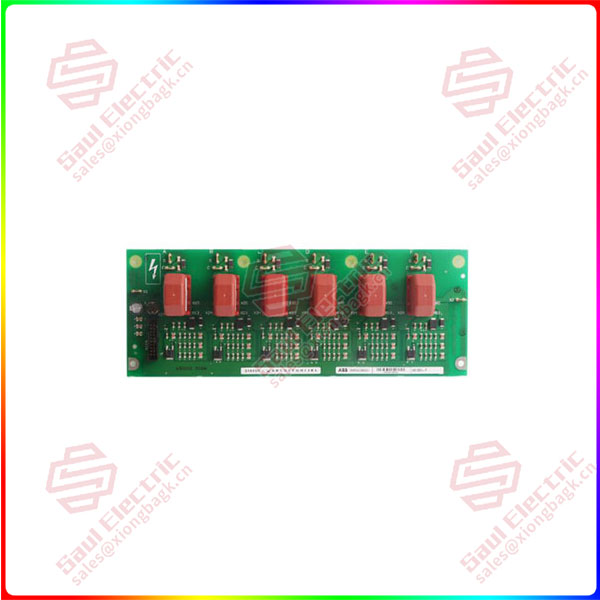
The ABB 3BHE050077R0102 UNS0881B-PV2 is a highly specialized and critical component within an ABB static excitation system, specifically a Gate Decoder Unit or Firing Module. This module, part of the UNS0881 series, is the intelligent interface responsible for controlling the firing (triggering) of the thyristors in the excitation system’s power converter. Its primary function is to receive low-voltage control signals from the automatic voltage regulator (AVR) controller, and convert them into precisely timed, high-power electrical pulses that are delivered to the gate terminals of the thyristors. These firing pulses determine the exact moment each thyristor begins to conduct, thereby controlling the DC output voltage supplied to the generator’s rotor field winding. The suffix
PV2indicates a specific variant, likely with modifications for performance, diagnostics, or compatibility.The core value of the ABB UNS0881B-PV2 lies in its precision, reliability, and integrated protection. It acts as the crucial link that translates the AVR’s control commands into physical power control. The module provides robust galvanic isolation (typically via fiber optics or pulse transformers) between the sensitive AVR electronics and the high-power, high-voltage environment of the thyristor bridge. It incorporates sophisticated monitoring circuits, including Breakover Diode (BOD) monitoring, to detect overvoltage conditions or failures on individual thyristors. For excitation system engineers and maintenance personnel, the proper operation of the UNS0881B-PV2 is essential for stable generator voltage regulation, fast dynamic response to grid disturbances, and the overall safety and reliability of the excitation system. A failure in this module can lead to loss of firing pulses, causing the excitation system to malfunction and potentially trip the generator.
Technical Specifications
|
Parameter Name
|
Parameter Value
|
|---|---|
|
Product Model
|
ABB 3BHE050077R0102 (Order Code) / UNS0881B-PV2 (Functional Designation)
|
|
Manufacturer
|
ABB
|
|
System Application
|
Static Excitation Systems (e.g., UNITROL® series)
|
|
Product Type
|
Thyristor Firing Module / Gate Decoder Unit
|
|
Primary Function
|
Generates and delivers firing pulses to thyristors based on AVR commands.
|
|
Input Interface
|
Receives firing command signals from the AVR controller, typically via optical fibers for isolation and noise immunity.
|
|
Output Interface
|
Provides high-current, isolated firing pulses to the gate-cathode terminals of one or more thyristors. Often has multiple output channels.
|
|
Pulse Characteristics
|
Generates pulses with precise timing (synchronized to the AC line), sufficient amplitude, and width to reliably turn on the connected thyristors.
|
|
Isolation
|
Provides high-voltage isolation (several kV) between the control side (AVR) and the power side (thyristor), commonly using fiber-optic links or high-voltage pulse transformers.
|
|
Thyristor Monitoring
|
Features Breakover Diode (BOD) monitoring circuitry. A BOD is a protective device across each thyristor. The firing module can detect if a BOD has conducted, which indicates an overvoltage event or a potential thyristor failure, and report this to the AVR.
|
|
Synchronization
|
Requires a synchronizing voltage signal (typically from the excitation transformer) to correctly time the firing pulses with the AC supply waveform.
|
|
Power Supply
|
Has its own regulated internal power supply, derived from the system, to generate the pulse energy.
|
|
Diagnostics
|
Self-monitors its internal operation, communication link with the AVR, and the status of the BOD monitoring circuits. Provides local LED status indication and communicates faults to the AVR.
|
|
Mounting
|
Designed for mounting on or near the thyristor heatsinks/bridge assembly within the excitation cubicle.
|
|
Operating Temperature
|
Industrial temperature range, typically designed for operation up to 70-85°C ambient near the power components.
|
|
Certifications
|
Designed to meet relevant IEC, UL, and other industry standards for power electronics.
|
Key Features and Advantages
ABB UNS0881B-PV2 (3BHE050077R0102) is distinguished by its precision and protective intelligence. Its foremost advantage is generating firing pulses with extremely accurate timing, which is critical for smooth, efficient control of the DC output voltage and for minimizing harmonic distortion. The use of fiber-optic communication for receiving firing commands ensures perfect electrical isolation, completely eliminating the risk of noise or transients from the power stage disrupting the sensitive AVR. This isolation is paramount for system reliability and longevity.
Integrated diagnostics and protection features are central to its value. The module’s ability to monitor the Breakover Diodes (BODs) on the thyristors provides a critical early warning system. If a thyristor experiences an excessive voltage spike (dv/dt), its associated BOD will conduct to protect it. The UNS0881B-PV2 detects this event and can report it to the AVR, allowing for an alarm or a controlled system response before a catastrophic thyristor failure occurs. This proactive diagnostic capability enables predictive maintenance and enhances system availability.
High reliability and optimized integration are key benefits. As a matched component designed specifically for ABB’s excitation systems, it guarantees optimal performance and compatibility with the AVR and the specific thyristor types used. Its design is optimized for the thermal and electrical environment of a power converter. For system integrators, it simplifies the interface design, reducing engineering complexity. In summary, the UNS0881B-PV2 provides the dependable, intelligent, and isolated «trigger» needed to accurately convert digital control commands into controlled power, forming an essential and robust link in the high-performance excitation control chain. Its failure directly impacts generator controllability, making its reliability a cornerstone of overall system availability.
Application Areas
The ABB UNS0881B-PV2 firing module is an integral part of static excitation systems for large synchronous generators and motors.
Its application is exclusively within ABB excitation systems, such as the UNITROL series, used in:
-
Utility-Scale Power Generation: Thermal (coal, gas), hydroelectric, and nuclear power plants, firing the thyristors in the generator’s excitation system.
-
Industrial Power Plants & Large Synchronous Motors: In co-generation facilities, and for driving large compressors, mills, and pumps.
-
Synchronous Condensers: For reactive power support systems on the electrical grid.
Essentially, wherever an ABB static excitation system employing a thyristor converter is used to control the field current of a synchronous machine, UNS0881B-PV2 (or a similar variant) firing modules are present to execute the precise switching commands. They are critical components in systems ranging from tens to hundreds of MVA.
Related Products
-
ABB UNITROL AVR Controller (e.g., UFC760, UNITROL 1020/5000): The digital regulator that sends firing commands to the UNS0881B-PV2.
-
ABB Thyristor (Power Stack) and Heat Sink Assembly: The power semiconductor devices that receive the firing pulses from this module.
-
Excitation Transformer: Provides the AC input power to the thyristor bridge and the synchronizing signal for the firing modules.
-
Fiber Optic Cables: The isolation media used to connect the AVR to the firing module and often the firing module to the thyristor gates.
-
Synchronizing and Power Supply Boards: Ancillary boards that provide the necessary reference signals and power to the firing modules.
-
ABB ToolKit SPAC Software: May be used for system-level configuration and diagnostics, which includes monitoring the status of the firing system.
Reviews
There are no reviews yet.