

Description
Product Overview
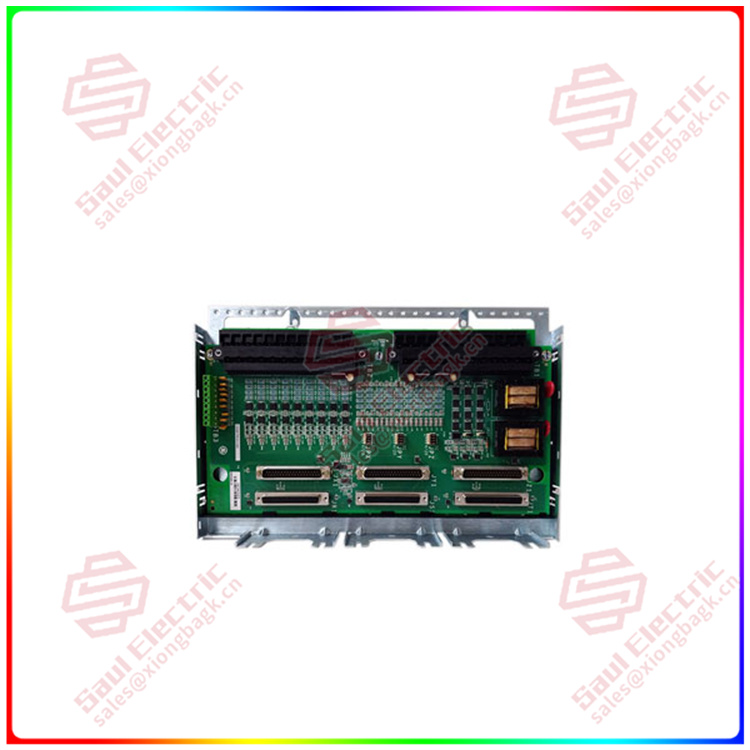
The GE IS230TNRLH1B is a critical Communication Interface Module from the General Electric (GE) Mark VI or Mark VIe Speedtronic™ gas/steam turbine control system. The module designation «TNR» typically stands for Terminal Network Relay, indicating that it functions as a communication repeater or interface between field devices located in terminal boxes or remote I/O cabinets and the main Mark VI controller. Its primary function is to extend the control system’s I/O network, manage a cluster of remote I/O points, and transmit the acquired data back to the main controller over a highly reliable, deterministic network (such as the VCMI network or a dedicated I/O bus). This module provides a key node for a distributed I/O architecture, allowing I/O termination to be placed closest to sensors and actuators, thereby reducing long analog signal wiring runs, improving signal integrity, and simplifying system cabling.
The core value of the GE IS230TNRLH1B lies in its ability to enable highly reliable distributed I/O. It acts as the intelligent manager for a remote I/O cluster, continuously scanning connected I/O modules, packaging data, and communicating with the main controller via redundant network paths. This design is essential for deploying hundreds of I/O points across large turbine packages (gas turbines, steam turbines), where I/O is widely distributed on the skid and auxiliary systems. The module’s reliable operation is critical to ensure that all critical turbine parameters (temperature, pressure, vibration) are accurately acquired and that all control commands are faithfully delivered. For system integrators and turbine engineers, the TNR module is a cornerstone for building scalable, high-availability control systems, ensuring that the control system’s «sensory nerve endings» can communicate reliably with its «brain» (the main controller).
Technical Specifications
|
Parameter Name
|
Parameter Value
|
|---|---|
|
Product Model
|
GE IS230TNRLH1B
|
|
Manufacturer
|
General Electric (GE)
|
|
System Platform
|
Mark VI / Mark VIe Speedtronic™ Turbine Control System
|
|
Product Type
|
Terminal Network Relay / Remote I/O Communication Interface Module
|
|
Primary Function
|
Manages a cluster of remote I/O modules; acts as a network node on the Mark VI I/O network (e.g., VCMI network).
|
|
Processor
|
Onboard microprocessor for I/O scanning, data management, and network communication.
|
|
I/O Network Interface
|
Connects to the Mark VI’s high-speed, deterministic I/O network (e.g., VCMI) to communicate with the main controller(s).
|
|
Local I/O Bus
|
Provides a local bus interface for connecting to multiple GE remote I/O packs (e.g., IS200 series analog and digital I/O modules).
|
|
Communication Ports
|
Likely includes status/configuration ports (e.g., RS-232/485) for local service.
|
|
Memory
|
Onboard memory for storing I/O configuration and application firmware.
|
|
Configuration
|
Fully configured using GE’s ToolboxST engineering software. This includes defining the attached I/O modules, their addresses, and mapping I/O points to controller database tags.
|
|
Power Supply
|
Powered from the Mark VI rack backplane or from a local power supply in the remote cabinet. May support redundant power inputs.
|
|
Operating Temperature
|
0°C to 60°C (standard for control cabinet environments).
|
|
Status Indication
|
Front-panel LEDs for power, network status, communication activity, and fault conditions.
|
|
Mounting
|
Designed as a plug-in module for a Mark VI compatible I/O rack or chassis.
|
|
Certifications
|
Designed to meet cULus, CE, and other relevant industrial standards.
|
Key Features and Advantages
GE IS230TNRLH1B excels as a key enabler for distributed I/O architecture. Its primary advantage is decoupling the I/O subsystem from the central controller’s physical location. This allows I/O termination cabinets to be installed in optimal locations—such as on the turbine base frame or near auxiliary systems—while the main controller remains in a centralized control room. This significantly reduces the amount of field wiring running back to the main cabinet, lowering installation costs and potential points of failure. The module provides a deterministic and high-speed data link to the main controller, ensuring that I/O data updates with the speed and reliability required for turbine control and protection.
Local intelligence and network efficiency are central to its value. The TNR module offloads the task of I/O scanning and management from the main controller. It continuously polls its local I/O modules, efficiently packages the data, and transmits it over the network. This reduces the communication load on the main controller’s backplane and improves overall system performance. Its design ensures robust communication in the electrically noisy environment of a power plant.
Scalability, ease of configuration, and high reliability are key benefits. The use of TNR modules allows the Mark VI system to be easily scaled to accommodate large, complex turbines with thousands of I/O points spread over a wide area. Configuration through the unified ToolboxST environment simplifies engineering. As a hardened industrial component, it is built for reliable 24/7 operation. For maintenance, if a remote I/O cluster fails, the issue can often be isolated to that cluster and its associated TNR module, simplifying troubleshooting. The module itself is a Field Replaceable Unit (FRU). In summary, the IS230TNRLH1B provides the critical communication and control infrastructure that makes the Mark VI system a truly distributed and scalable platform for modern turbine automation.
Application Areas
The GE IS230TNRLH1B module is deployed in GE Mark VI/Mark VIe turbine control systems requiring distributed I/O architecture.
Its primary application is in large gas turbine and steam turbine packages, where I/O points are geographically dispersed:
-
Turbine Skid I/O: Managing I/O located on the turbine base itself (vibration probes, thermocouples, solenoid valves).
-
Auxiliary System Control: Managing I/O for lube oil consoles, fuel skids, cooling water systems, and generator excitation systems located in separate cabinets or skids.
-
Compressor Stations: In mechanical drive applications for compressors, where I/O is spread along the driven equipment.
It enables the creation of remote I/O drops throughout the turbine package, connecting them back to the central Mark VI controller unit. Essentially, the TNR module is used wherever a GE Mark VI system needs to efficiently manage a large number of I/O points that are not collocated with the main controller, which is a common scenario in complex turbine installations.
Related Products
-
GE Mark VI/Mark VIe Main Controller (e.g., IS200/IS215 series): The primary controller that communicates with the TNR module over the network.
-
GE Mark VI Remote I/O Modules (IS200 series, e.g., AEPA, DDPC): The analog and digital I/O modules managed by the TNR module in a remote cabinet.
-
GE Mark VI I/O Network Hardware: Cables, terminators, and possibly repeaters for the VCMI or other I/O network connecting TNR modules to the main controller.
-
GE ToolboxST Software: The essential engineering tool for configuring the TNR module, defining its I/O module inventory, and mapping data points.
-
Remote I/O Cabinet & Power Supply: The enclosure and power system for the remote I/O cluster managed by the TNR.
-
Communication Cables (Fiber/Ethernet/Coaxial): The physical media for the I/O network, depending on the system design.
Reviews
There are no reviews yet.