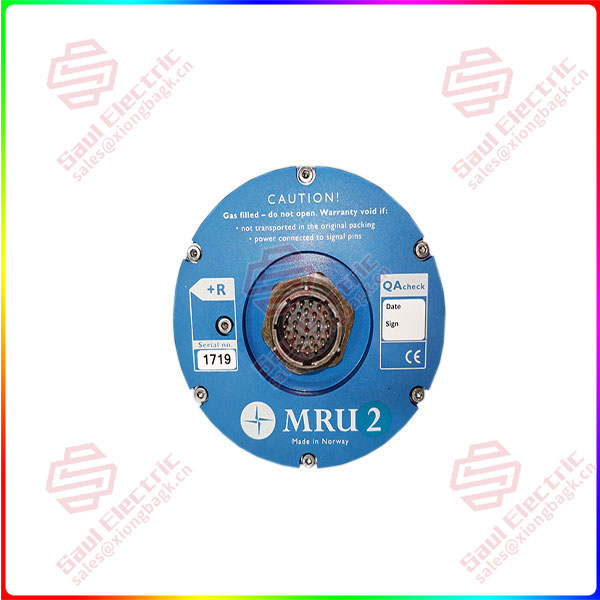
The KONGSBERG MRU-M-MB2 is a high-precision, dual-antenna Motion Reference Unit (MRU), a specialized inertial sensor system manufactured by Kongsberg Maritime, a global leader in marine technology. This advanced device is engineered to provide extremely accurate, real-time measurements of a vessel’s or offshore platform’s motion in six degrees of freedom (6DOF). It precisely measures heave, surge, sway (linear motions) and roll, pitch, yaw (angular rotations), with a particular emphasis on delivering ultra-stable and reliable heave data. The «MB2» designation typically signifies a specific model within the MRU-M series, often indicating performance grade, interface options, or housing specifications. As a critical sensor in dynamic positioning (DP), vessel monitoring, and offshore operations, the KONGSBERG MRU-M-MB2 serves as the primary source of truth for a vessel’s movement relative to a fixed point or its own heading.
The core value of the KONGSBERG MRU-M-MB2 lies in its fusion of high-grade inertial sensors (accelerometers and gyroscopes) with sophisticated signal processing algorithms, including advanced Kalman filtering. It compensates for errors inherent in individual sensors to output compensated, low-noise motion data. The dual-antenna configuration (integrated or supporting external GNSS antennas) is a key feature that significantly enhances heading accuracy and integrity by calculating heading from the relative position of two GPS antennas, independent of traditional magnetic compasses. This makes it immune to magnetic disturbances common on steel-hulled vessels. For DP operators, ship masters, and offshore engineers, the data from the MRU-M-MB2 is indispensable for maintaining station, conducting precise offshore lifting operations, performing hydrographic surveys, and ensuring safety during heavy weather, as it feeds critical motion data into control and stabilization systems.
Technical Specifications
Parameter Name
Parameter Value
Product Model
KONGSBERG MRU-M-MB2
Manufacturer
Kongsberg Maritime
Product Type
Dual-Antenna Motion Reference Unit (MRU) / Inertial Measurement Unit (IMU)
Motion Measurements
Heave, Surge, Sway, Roll, Pitch, Yaw (Heading)
Heave Accuracy
Very high accuracy, typically in the range of ±5 cm or 5% of motion (whichever is greater) under specified conditions.
Attitude Accuracy (Roll/Pitch)
Typically ±0.1° or better under dynamic conditions.
Heading Accuracy
Dual-antenna GNSS-derived heading, typically ±0.1° relative to True North (dependent on baseline length and GNSS signal quality).
Update Rate
High output rate (e.g., up to 100 Hz) for real-time control applications.
GPS, GLONASS, and often Galileo/BeiDou for robust positioning and heading.
Interfaces
Standard serial interfaces (RS-422/485), Ethernet (TCP/IP, UDP), NMEA 0183/GPGGA/GPHDT outputs. Likely supports proprietary KONGSBERG protocols (e.g., K-Controller Bus).
Power Supply
10-36 V DC, typical for marine applications.
Operating Temperature
-25°C to +70°C (or wider range) for harsh marine environments.
Environmental Protection
High IP rating (e.g., IP66/IP67) or equivalent, corrosion-resistant housing.
Certifications
Marine type-approved (e.g., DNV-GL, ABS, LR) for critical navigation and control applications.
Key Features and Advantages
The defining feature of the KONGSBERG MRU-M-MB2 is its dual-antenna GNSS heading capability. By utilizing two high-precision GNSS receivers with a fixed baseline (distance between antennas), it computes true heading with exceptional accuracy and reliability, free from the magnetic deviations and soft-iron errors that plague traditional gyrocompasses. This provides a constant, drift-free heading reference crucial for DP operations and precise navigation.
MRU-M-MB3
Ultra-stable heave measurement is its primary purpose. Through advanced sensor fusion algorithms that combine inertial data with GNSS velocity/position, the unit filters out high-frequency noise (like vibration) and low-frequency drift, delivering a clean, accurate heave signal. This is vital for offshore crane operations, sonar deployment, and any task where knowing the exact vertical movement of a reference point on the vessel is critical. The high data output rate and low latency ensure that motion data is delivered to the DP system or other consumers with minimal delay, enabling tight control loops and rapid response to wave-induced motions.
Robustness and reliability for the marine environment are engineered into its core. The unit is built to withstand the harsh conditions of offshore operations: salt spray, wide temperature variations, humidity, and constant vibration. Its high ingress protection rating ensures longevity. Seamless integration with Kongsberg’s ecosystem is a major advantage. It is designed to plug-and-play with Kongsberg’s DP systems (K-Pos, K-Chief), position reference systems, and other bridge electronics, using optimized communication protocols. This integration simplifies installation, configuration, and diagnostics, providing a single-vendor solution for critical motion sensing that is trusted in the most demanding offshore and maritime applications.
Application Areas
The KONGSBERG MRU-M-MB2 is a critical sensor deployed in applications where precise knowledge of vessel motion is non-negotiable for safety, efficiency, and operational success.
Its primary domain is Dynamic Positioning (DP) systems on vessels such as offshore supply vessels, drilling rigs, pipelay vessels, and cruise ships. Here, it provides the essential roll, pitch, and heave data used by the DP controller to counteract environmental forces (wind, waves, current) and maintain station or follow a precise track.
In offshore construction and heavy lifting, it is used on crane vessels and installation ships. The accurate heave, roll, and pitch data are fed into Active Heave Compensation (AHC) systems for cranes, allowing them to maintain a load steady relative to the seabed or a fixed structure despite vessel movement.
For hydrographic and seismic survey vessels, the MRU-M-MB2 supplies precise motion data to correct the position of multibeam sonar heads, streamers, or other underwater sensors, ensuring the accuracy of seabed mapping and sub-bottom profiling data.
Within naval and specialized marine operations, it provides vital motion input for weapon systems stabilization, unmanned surface vehicle (USV) control, and high-speed craft maneuverability analysis. Essentially, any maritime operation requiring sub-degree attitude accuracy and centimeter-level heave measurement under dynamic conditions relies on a sensor of the caliber of the KONGSBERG MRU-M-MB2.
Related Products
KONGSBERG MRU-M (other variants): Such as MRU-M-MB1 (potentially single antenna or different performance grade) or MRU-M-MS (with different housing or interfaces).
KONGSBERG GNSS Antennas (e.g., SA-2030M): The high-precision, marine-grade GNSS antennas used with the dual-antenna MRU system.
KONGSBERG K-Pos DP Control System: The dynamic positioning system that directly uses motion data from the MRU-M-MB2.
KONGSBERG K-Bridge / K-Chief Integrated Bridge System: The vessel management system that may display motion data and use it for navigation decisions.
KONGSBERG HiPAP / APOS Positioning Systems: Acoustic positioning systems that may integrate MRU data for vessel reference frame translation.
Motion Sensor Interface Unit: A possible ancillary unit for signal distribution or conversion if needed for non-Kongsberg systems.
KONGSBERG K-IMS (Information Management System): Software platform for data logging, analysis, and visualization of MRU and other sensor data.
Competitor MRUs (e.g., Applanix, SBG Systems, iXblue): Alternative motion sensing systems used in similar applications.
Reviews
There are no reviews yet.
Be the first to review “KONGSBERG MRU-M-MB2 dual-antenna Motion Reference Unit (MRU)” Отменить ответ



Reviews
There are no reviews yet.