

Description
Product Overview
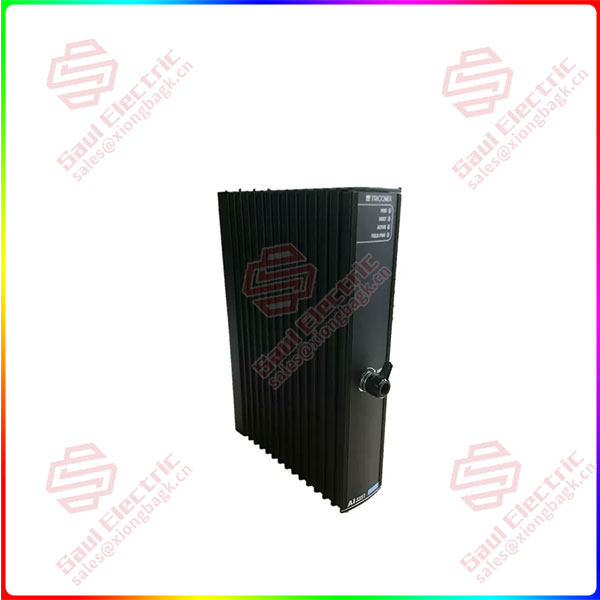
The Triconex 3351 is a single-channel, 24V DC digital output module for the Tricon Triple Modular Redundant (TMR) Safety Instrumented System (SIS) platform. It is a legacy, non-TMR (simplex) output module designed for applications where a single fault tolerant architecture is not required for the output signal. The 3351 provides a cost-effective means to drive non-critical field loads—such as indicator lamps, alarms, or solenoid valves for non-safety functions—from within a Tricon system, but it is not designed for safety-critical actuation where a dangerous failure (failure to de-energize) could lead to a hazardous event. It is primarily used for auxiliary control, annunciation, or permissive functions within a plant where the high-integrity TMR output modules (like the 3504E) are not justified.
The core value of the Triconex 3351 lies in its role as an economical expansion of the Tricon platform’s output capabilities for non-safety functions. It allows system designers to consolidate both safety and non-safety control within the same, reliable Tricon hardware and software environment, simplifying the overall control architecture. For engineers, it provides a reliable, solid-state output solution that leverages the Tricon infrastructure for sequencing, permissives, and status indication, without incurring the cost and complexity of triple-redundant hardware. It is critical to understand that the 3351 is a 1oo1 (single-channel) device. Its use in any Safety Instrumented Function (SIF) would severely compromise the safety integrity of that loop, as it lacks the internal diagnostics and fault tolerance required for SIL-rated applications. Its application must be strictly limited to non-critical functions as defined in the safety requirements specification (SRS).
Technical Specifications
|
Parameter Name
|
Parameter Value
|
|---|---|
|
Product Model
|
Triconex 3351
|
|
Manufacturer
|
Invensys Triconex (now Schneider Electric)
|
|
Product Family
|
Tricon Simplex (Non-TMR) Digital Output Module
|
|
Primary Function
|
16-point, 24V DC Single-Channel (Simplex) Digital Output Module
|
Electrical Characteristics (Per Channel)
-
Output Type: Solid-State, Sourcing (Current Sourcing) Output. The module switches the positive side of the 24V DC supply to the load.
-
Output Voltage: Nominal 24V DC. Compatible with standard industrial control voltage.
-
Output Current Rating: Typically 0.5 Amps per point continuous, with a lower total current limit for the entire module. Suitable for driving relays, solenoid valves, and pilot lamps directly.
-
On-State Voltage Drop: Typically 1.0V to 1.5V, resulting in ~22.5V at the load.
-
Off-State Leakage Current: Very low (< 1 mA) to prevent unintended load activation.
-
Response Time: Turn-on and turn-off times are fast, typically in the microsecond to low millisecond range.
-
Point Density: 16 points per module.Safety & Architecture
-
Architecture: Single-Channel (Simplex). This is NOT a TMR module. Each output point is controlled by a single solid-state switch. There is no internal voting or redundant circuitry. A single component failure in the output path can lead to a dangerous failure (e.g., stuck ON).
-
Diagnostics: Basic diagnostics are limited. The module may have status feedback for power and communication, but it lacks the advanced diagnostics of TMR modules (such as output circuit validation, open load/short circuit detection, and cross-channel comparison). It cannot detect a failed output transistor in the ON state.
-
Protection: May include basic fusing or electronic current limiting on a per-point or per-group basis to protect against sustained short circuits. This is for equipment protection, not safety diagnostics.
-
Effect on Safety Loop: Using a simplex output module like the 3351 to drive a final element in a safety loop is generally not permissible for SIL 2 or SIL 3 applications unless it is part of a 1oo2 or 2oo3 voted output architecture using multiple, diverse 3351 modules—a complex and uncommon design. Its use typically relegates the associated function to a non-safety or low-demand auxiliary role.Mechanical & Integration
-
Form Factor: A module designed for installation in a legacy Tricon I/O chassis. It is not hot-swappable. Its physical form is typically different from the newer High-Density (HD) TMR modules.
-
Termination: Field wiring connects via a removable terminal block on the front of the module or through a connected terminator assembly.
-
LED Indicators: Per-point status LEDs to indicate the commanded ON/OFF state of each output.
-
Compatibility: Designed to work with older Tricon chassis and main processors (e.g., Tricon v8, early v9 systems). It requires a specific, matching I/O terminator or carrier board (e.g., 8351T).Environmental
-
Operating Temperature: 0 to 60°C (32 to 140°F) typical for industrial environments.
Key Features and Advantages
Cost-Effective Output Expansion: Provides 16 output points at a significantly lower cost per point than a TMR output module, making it economical for driving a large number of non-critical loads.
Consolidated Control within Tricon Platform: Enables both critical safety logic (using TMR I/O) and auxiliary plant control/logic to be performed within the same, high-availability Tricon controller, using a single engineering and maintenance environment (TriStation 1131).
Reliable Solid-State Switching: Offers fast, reliable switching for inductive and resistive loads commonly found in industrial settings, with a robust design for long service life in non-safety applications.
Simplified Design and Sparing: Reduces system complexity and spare parts inventory by using the same platform for multiple functions.
Application Areas (Non-Safety)
The Triconex 3351 is strictly for non-safety, auxiliary control functions within a Tricon-based system.
-
Annunciation and Indication: Activating general alarm horns, stack lights, and status lamps (running, stopped, fault) on panels and field devices.
-
Permissive and Sequencing Logic: Controlling non-critical motors, pumps, or conveyors as part of a sequence that is not itself a safety function.
-
Valve Control for Non-Safety Functions: Operating solenoid valves for utility services (e.g., cooling water, instrument air) where a failure does not pose a direct safety hazard.
-
Interface to Other Systems: Providing command outputs to the Basic Process Control System (BPCS), skid-mounted packages, or other subsystems for non-safety interlocking.
-
Testing and Bypass Functions: Controlling outputs for test circuits or maintenance bypass indications.
Related Products
-
Tricon Chassis: Legacy Tricon Chassis models (e.g., 10-slot chassis) that provide the backplane and power for the module.
-
Tricon Main Processor (MP): The controller (e.g., MP 3008) that issues the output commands.
-
I/O Terminator / Carrier Board: A required mating unit such as the 8351T Terminator that provides the field wiring terminals, fuses, and status indication circuitry. The 3351 module plugs into this terminator.
-
External Power Supply: A reliable, external 24V DC power supply is required to power the field loads switched by the 3351.
-
Flyback/Protection Diodes: For driving inductive loads (solenoids, relay coils), external flyback diodes are strongly recommended across each load to protect the module’s output transistors from voltage spikes caused by inductive kickback.
-
Triconex TriStation 1131: The configuration software used to define the module in the hardware configuration and write the logic that controls the outputs.
-
TMR Output Modules: Such as the 3504E (24V DC TMR DO) for safety-critical final element control.
Reviews
There are no reviews yet.