

Description
WOODWARD 5437-523 — Technical Overview
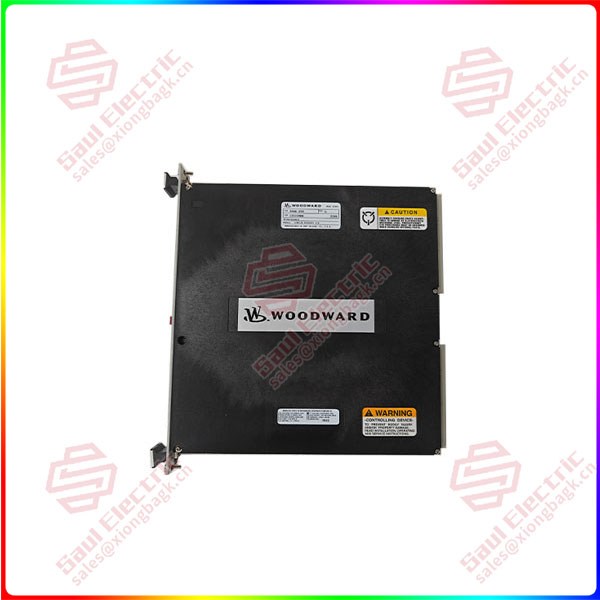
Product: 5437-523, Digital Servo / Actuator Driver
Manufacturer: Woodward, Inc.
Primary Application: A digital servo driver module designed to interface with and control electro-hydraulic actuators (servo valves) or electric actuators used for precise positioning of fuel racks, inlet guide vanes, or other control elements in diesel engines, gas engines, and gas turbines.
1. Core Overview & Positioning
The Woodward 5437-523 is a critical component within Woodward’s engine and turbine control systems. It functions as the power interface and closed-loop position controller between a digital governor (like a 723PLUS, 2301A, or NetCon) and the final actuating device.
Key Philosophy: It translates a low-power position command signal from the main controller into a high-power, modulated drive signal for a servo valve coil or electric actuator motor. It also reads feedback from a position sensor (LVDT/RVDT) to ensure accurate, stable positioning.
2. Key Features & Functions
-
Servo Amplifier: Provides the necessary current/voltage to drive inductive loads of servo valve coils or actuator motors.
-
Closed-Loop Control: Executes a fast, inner control loop using position feedback from an LVDT (Linear Variable Differential Transformer) or RVDT (Rotary Variable Differential Transformer) to achieve precise positioning.
-
Dual Inputs: Typically accepts a position command signal (e.g., ±10V DC, 4-20mA) from the primary speed/load controller and a position feedback signal from the actuator-mounted LVDT/RVDT.
-
Advanced Diagnostics: Continuously monitors key parameters such as coil current, feedback signal health, and tracking error. It can detect and report faults like open/short circuits, LVDT failure, or excessive deviation.
-
Configurable Parameters: Allows tuning of servo loop gains (Proportional, Integral), null/bias adjustments, current limits, and response characteristics via configuration software to match the specific actuator dynamics.
-
Status & Fault Indication: Equipped with LEDs to indicate power, run status, communication activity, and specific fault conditions.
3. Common Technical Specifications
-
Part Number Context: The base number (5437) indicates the product family (servo/actuator drivers), and the suffix (523) specifies the exact hardware variant, which defines voltage ranges, connector types, and output drive capabilities.
-
Command Input: Analog (±10V DC, 4-20mA) or digital (synchronous serial from a compatible Woodward controller).
-
Feedback Input: AC-excited LVDT/RVDT (typical excitation: 2.5 — 5 Vrms, frequency: 2.5 — 10 kHz).
-
Output Drive: Capable of driving typical servo valve coils (e.g., current output in the range of ±40 mA to ±300 mA, depending on the specific 5437 model and coil impedance).
-
Power Supply: Requires DC power, commonly ±15 V DC for analog circuitry and +24 V DC for the output drive stage.
-
Communication: Often includes a Woodward proprietary communication port (e.g., for Gov. Bus/NetBus) for configuration and diagnostics via Woodward Toolkit software.
-
Physical Form: Typically a printed circuit board (PCB) module designed for mounting inside a Woodward control cabinet or a custom enclosure.
4. System Integration & Configuration
-
Role in Control Architecture: It is the final control element driver in a cascade control loop:
-
Primary Controller: Calculates the required fuel or air setpoint.
-
Servo Driver (5437-523): Receives the setpoint as a command and drives the actuator to that exact position.
-
Actuator & LVDT: The physical device and its position sensor complete the loop.
-
-
Configuration Tool: Configured, tuned, and calibrated using Woodward Toolkit software connected via a service port or network.
-
Calibration: A critical setup procedure involves calibrating the LVDT feedback span and offset to match the actuator’s mechanical stroke, ensuring commanded position equals actual position.
5. Typical Applications
This module is essential for precise motion control in fuel and air management systems for:
-
Diesel Engines: Controlling the fuel injection rack or actuator on engines for power generation, marine propulsion, or locomotives.
-
Gas Engines: Positioning gas admission valves or throttle valves.
-
Gas Turbines: Driving fuel metering valves, inlet guide vanes (IGVs), or bleed valves for performance and surge control.
-
Steam Turbines: Governing steam inlet control valves.
Reviews
There are no reviews yet.